

When 29-year-old Naserian left her office job in Athi River to pursue her dream of farming, many thought she had lost it.
“Ati you quit a salaried job to farm sukuma and tomatoes?”
Her relatives laughed.
Her friends whispered.
Even the mama mboga near her estate told her farming nowadays is “a game of loss” because water is expensive and the climate has become unpredictable.
But Aisha had a dream, to grow fresh, chemical-free vegetables and supply households and restaurants in Kitengela. She rented a small plot, bought seeds and every morning before sunrise, she carried a 20-litre jerican and watered her crops by hand. Some days she watered twice, sometimes three times. She would go to bed exhausted, only to wake up to wilted leaves or dry patches where water never reached.

Weeks passed…
Some crops thrived. Others dried.
Her water bill kept rising.
The labour was draining.
She almost gave up.
Until the day she discovered Drip Irrigation.
The Turning Point: Watering That Works For You, Not Against You
Aisha visited a neighbour’s farm and saw something different. No back-breaking watering. No water wastage. The soil was moist, not flooded and the crops stood tall, green and uniform.
Small pipes ran along each row, delivering water directly to the roots.
Every drop counted.
Every plant received equal feeding.
That day, she learned about Drip Irrigation, a simple system that changed everything.
Within one month of installing a drip home kit:
✅ Water usage dropped by nearly half
✅ Her crops grew stronger, healthier and more uniform
✅ She harvested earlier and in higher quantities
✅ She started supplying to three households and a café nearby
Her friends who laughed?
They suddenly wanted “farming advice.”
Her relatives who doubted her?
They now ask when she’s expanding.
What Exactly Is Drip Irrigation and Why Are Smart Farmers Adopting It?
Drip irrigation is a method where water flows slowly through pipes and tiny emitters, directly to the plant’s root zone.
In simple words:
You water the plant, not the soil around it, not the weeds.
It is one of the most efficient irrigation systems because it:
- Saves up to 60% of water
- Reduces weeds (water only goes where it’s needed)
- Prevents fungal diseases caused by leaf wetting
- Improves yields and quality
- Requires very little labour once installed
- Works well even with limited water or on a gravity tank setup
For young farmers, busy professionals and anyone starting a kitchen garden or agribusiness — this system is truly a blessing.
Which Crops Benefit Most from Drip Irrigation?

This system works beautifully for:
Vegetables (Shamba Basics)
Tomatoes, onions, sukuma wiki, spinach, cabbages, carrots, beetroots, cauliflower, capsicum, cucumbers
Fruits
Strawberries, watermelon, passionfruit, tree tomatoes, citrus fruits, pawpaw
Herbs & Spices
Dhania (coriander), rosemary, garlic, mint, ginger, thyme
Greenhouse Farming
Tomatoes, peppers, cucumbers, lettuce
Flowers & Home Gardens
Flower beds, potted plants, landscaping
Whether you’re farming on ¼ acre in Kiambu, a backyard in Syokimau, a greenhouse in Naivasha, or a homestead in Kisumu, drip irrigation fits perfectly.
What Comes in a Drip Irrigation Starter Kit?
A complete home kit usually includes:
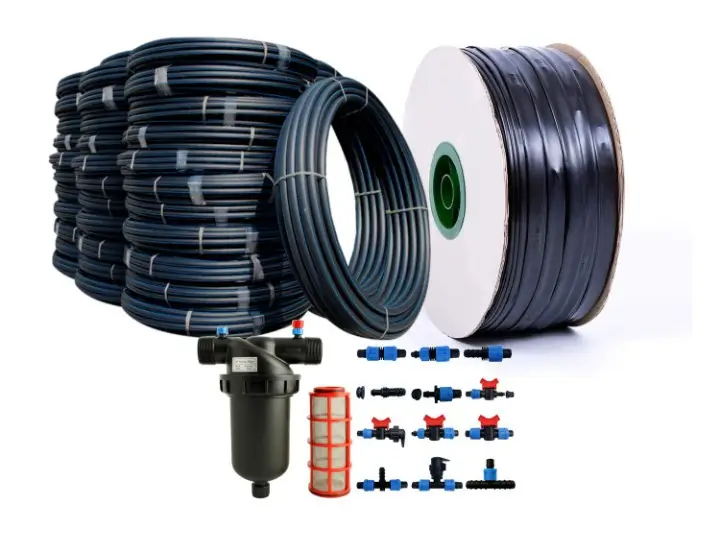
- Main line pipe (16-32mm)
- Drip lines with built-in emitters spaced for your crop type
- Connectors (tees, joiners, elbows, starter connectors)
- End caps
- Filter to prevent clogging
- Pressure regulator
- Optional: Water pump, depending on your water source
Important Tip:
Don’t go for the cheapest kit in the market. Low-quality pipes burst under the sun and clog easily.
Choose UV-treated and durable grade pipes for long lifespan and reliability.
How to Install a Drip Kit – The Simple Way
Even if you’re not “technical”, installing a drip kit is easy if you follow these steps:
1. Plan Your Layout
Measure your space, sketch it, and mark your crop rows.
Ensure spacing matches crop type (e.g., tomatoes need 30–45cm spacing).
2. Connect Your Water Source
Attach filter + pressure regulator to your tap or tank.
For gravity-fed systems: raise tank 1.5-2 meters high for good flow.
3. Lay the Main Line
Run the main pipe straight along your planting area.
4. Add Drip Lines
Use connectors to attach drip lines along each crop row – placing them near the roots.
5. Seal & Test
Close pipe ends, open water, and check for equal flow.
6. Mulch if Possible
Mulch helps soil retain moisture and reduces evaporation.
Within 1-2 hours, your system can be up and running.
Mistakes That Make Farmers Lose Money
Aisha was fortunate she got guidance. But many farmers lose crops because of avoidable mistakes. Avoid:
❌ Buying low-grade pipes that crack in the sun
❌ Installing without a filter
❌ Wrong spacing – leads to under or overwatering
❌ Skipping flushing – leads to blocked emitters
❌ Leaving pipes exposed to harsh sunlight
A little expert guidance can save you months of losses.
Why Eden Lawn & Garden Centre Is the Trusted Choice for Drip Irrigation

At Eden, we know farming is not just “plant and pray”. It’s science, smart planning, and quality tools.
We don’t just sell you a kit.
We guide, install, train, and walk the journey with you.
We supply:
✅ Complete Drip Irrigation Kits
✅ Sprinklers & Micro-Sprayers
✅ Quality Drip Lines & Main Pipes
✅ Filters, Valves, & Irrigation Fittings
✅ Water Pumps for Irrigation
✅ Rain Guns for Larger Farms
Whether you’re a beginner like Aisha or scaling to commercial level — you deserve the right system, installed the right way.
Ready to Transform Your Farm Like Aisha?
You don’t need to wait for “someday”.
Your breakthrough can begin with a simple drip kit today.

Call Eden and speak to our irrigation technicians for guidance, pricing and installation support.
📍 Visit us: Teco Mall, Mombasa Road – Nairobi
📞 Call/WhatsApp: 0792478 000
📧 Email: sales@edenlg.co.ke
Request a FREE QUOTE and let Eden help you build a thriving, water-efficient farm — one drop at a time.
